EU LNG imports from Russia rise as sanctions package stalls
A Greek objection over specialised Arctic carriers has blocked the EU's 21st sanctions package, while bloc-wide imports of Russian LNG climbed 16% in the first half of 2026.
THE NEWS
According to Marine Insight, the European Union's effort to tighten restrictions on Russian LNG has encountered a significant obstacle: Greece has withheld support for the bloc's 21st sanctions package against Moscow. Athens argues that the proposed measures would critically damage Dynagas, a shipping company controlled by Greek shipowner George Prokopiou. Because EU sanctions require unanimity among member states, the Greek objection has left a broader set of proposed measures — targeting Russian financial institutions, drone manufacturers, cryptocurrency networks, and oil traders — unresolved.
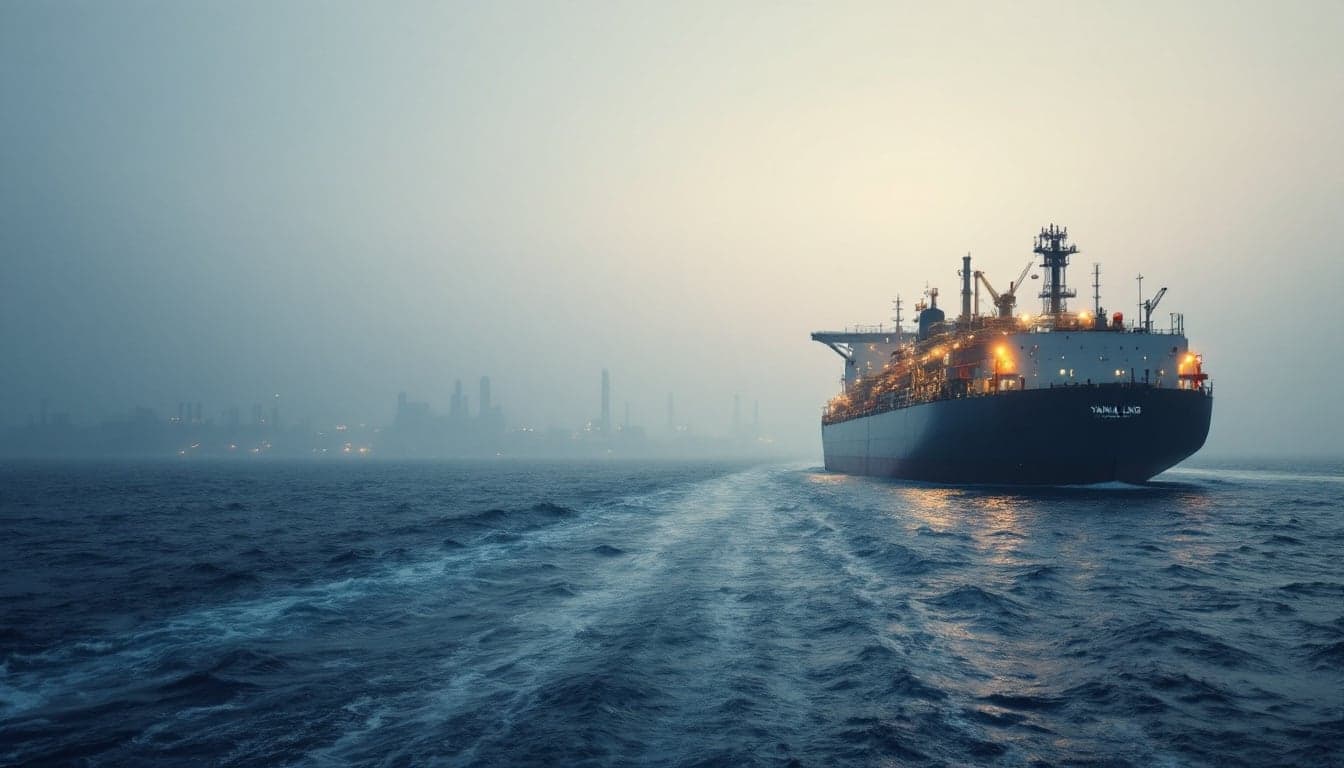
At the centre of the dispute are four Arc7 icebreaking LNG carriers operated by Dynagas and built specifically for Russia's Yamal project. These vessels represent approximately one-third of the specialised fleet capable of navigating the Arctic's Gulf of Ob in winter conditions. Greece contends that a ban on shipping Russian LNG to third countries would compel Dynagas to divest these assets to non-Western buyers — an outcome that, Athens argues, would remove European oversight without actually halting the movement of Russian gas. Two of Dynagas's standard vessels also remain under long-term charters extending beyond 2030, with the Yamal trade accounting for 35% of the partnership's revenue in 2025.
Meanwhile, industry data cited by Marine Insight show that EU countries imported 9.97 million tonnes of LNG from Yamal in the first half of 2026, a 16% increase relative to the same period in 2025, valued at €5.96 billion. France, Belgium, and Spain were the leading importers. Experts attribute the surge partly to companies front-loading supplies ahead of anticipated tighter rules, and partly to previous EU bans on transshipping Russian LNG outside the bloc, which redirected volumes inward.
WHY IT MATTERS
For Brazilian offshore professionals, the direct operational impact of this dispute is limited — Brazil neither imports Russian LNG nor operates Arc7 carriers. The relevance is structural and market-level: the episode illustrates how deeply European energy policy remains entangled with supply security concerns, and how that entanglement shapes the global LNG trade that Brazil is increasingly positioning itself to serve.
Brazil's pre-salt gas monetisation strategy depends, in part, on a credible export pathway for LNG. The country has no operational LNG export terminal at present, but several pre-salt development scenarios involve associated gas volumes that could support future liquefaction capacity. The European market, which has been actively diversifying away from pipeline gas since 2022, represents a logical long-term destination. Understanding the policy friction within the EU — and the pace at which European buyers can actually reduce Russian LNG dependence — is therefore relevant context for any Brazilian operator or regulator thinking about LNG export feasibility on a decade-long horizon.
The 16% year-on-year rise in EU imports from Yamal is a structurally important data point. It signals that European buyers, despite the political direction set in Brussels, are still optimising for price and supply security in the near term. This front-loading behaviour suggests that any genuine demand opening for alternative LNG suppliers — including potential future Brazilian volumes — may be slower to materialise than the headline sanctions narrative implies. Brazilian planners should read this not as discouragement, but as a calibration signal: the European market's transition away from Russian LNG is proceeding, but non-linearly.
The Greek objection also surfaces a dynamic that recurs in global energy governance: the gap between a bloc's stated policy direction and the commercial interests of individual member states or their national shipping industries. Cyprus and Malta have raised similar concerns about the effect of sanctions on European maritime businesses. This tension is not unique to Europe. In Brazil, the ANP and CNPE regularly navigate analogous pressures between national energy policy objectives and the commercial realities facing domestic operators, contractors, and shipowners. The EU case is a useful reference point for how those tensions can delay or dilute regulatory action even when political will exists at the central level.
From a shipping market perspective, the Arc7 carrier situation is worth noting for its technical specificity. These vessels were purpose-built for Arctic ice conditions and are, by the source's account, difficult to redeploy commercially. The concern that sanctions could transfer ownership of this specialised tonnage to non-Western buyers reflects a broader anxiety in Western maritime policy circles about the gradual reorientation of specialised offshore and energy-related shipping assets toward operators outside OECD oversight. Brazilian maritime stakeholders — particularly those involved in the construction and operation of specialised vessels for the pre-salt environment — may find the regulatory and commercial logic of this debate instructive, even if the specific asset class is distant from Brazilian operations.
CONTEXT
The current episode is one chapter in a longer EU policy arc that began accelerating after 2022. The bloc has progressively tightened restrictions on Russian energy, but LNG has consistently proven harder to restrict than pipeline gas, partly because it trades on a global spot market and partly because the infrastructure dependencies are less direct. The transshipment ban referenced in the source — which redirected Russian LNG volumes into European ports rather than onward to Asia — is itself an example of a measure producing market effects that diverged from its intended strategic outcome.
For the global LNG market, the combination of front-loading behaviour by European buyers and the unresolved sanctions package creates a period of elevated uncertainty around Russian Arctic LNG supply chains. How that uncertainty resolves — whether through a negotiated EU compromise, a Greek concession, or a prolonged impasse — will have downstream effects on spot LNG pricing and on the competitive positioning of alternative suppliers. Brazil's role in that picture remains prospective rather than immediate, but the structural dynamics being set now will shape the market that any future Brazilian LNG export project would enter.
Source: MARINE INSIGHT