Murphy Oil's Côte d'Ivoire discovery adds data to West Africa's exploration cycle
A new oil find offshore Côte d'Ivoire reinforces West Africa's position as an active frontier — with indirect signals for how capital and rigs are allocated globally.
THE NEWS
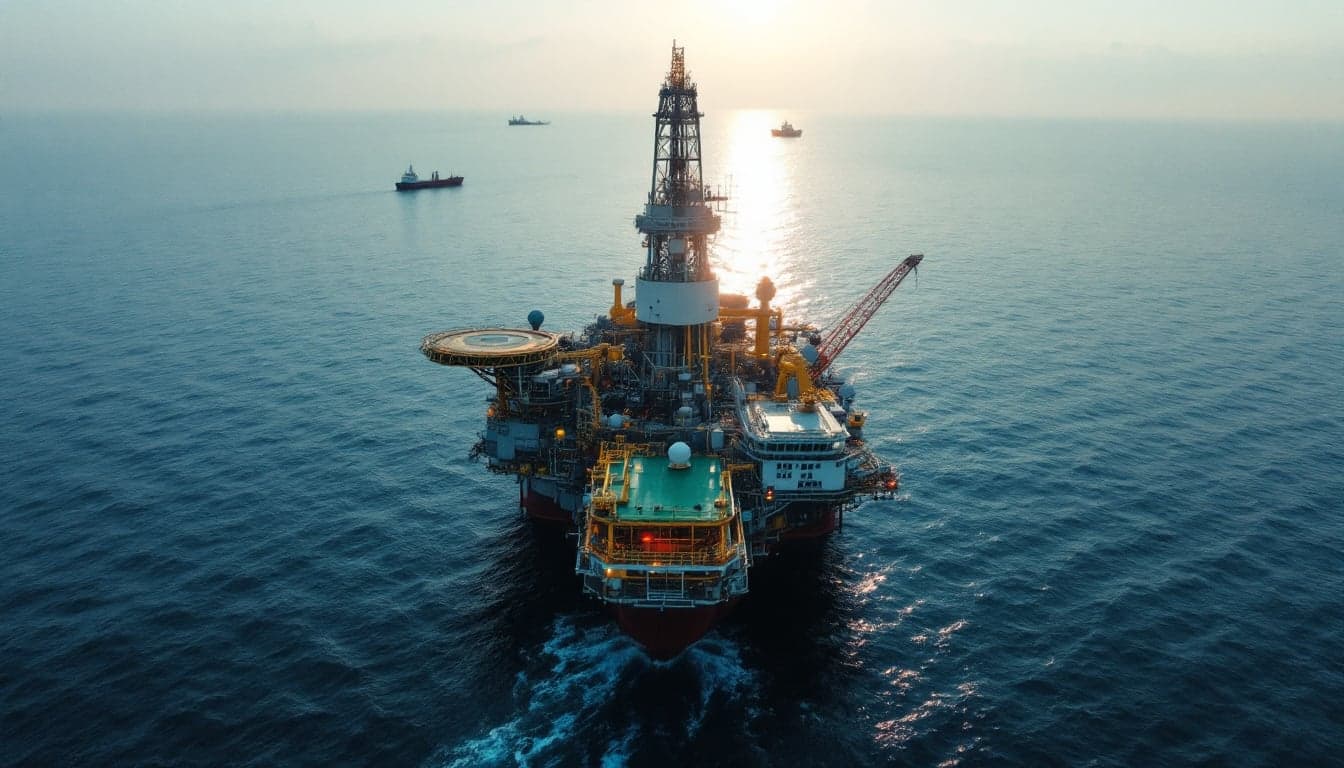
According to Offshore Engineer, Murphy Oil Corporation has confirmed an oil discovery at its Bubale-1X exploration well, drilled in a block offshore Côte d'Ivoire, West Africa. The U.S. independent operator announced the find as a positive result from the well, which was targeting prospective resources in the block.
The source article does not specify the estimated resource volume, the well's water depth, or the identity of any consortium partners involved in the block. Murphy Oil has not, based on the available reporting, indicated a timeline for appraisal or development activities.
The Bubale-1X result represents a confirmed oil presence in the acreage, adding to the body of exploration data for the block and for the broader sub-region.
WHY IT MATTERS
For Brazilian offshore professionals, a discovery by a mid-size U.S. independent in West Africa carries limited immediate operational consequence. Brazilian relevance here is structural rather than direct — and that framing is worth unpacking.
West Africa and Brazil's pre-salt province share geological heritage. The two continental margins were once joined, and the passive margin systems that host pre-salt carbonates on the Brazilian side have analogues along the West African coast. This geological kinship has long informed how exploration companies think about basin prospectivity on both sides of the Atlantic. A successful well in West Africa does not validate Brazilian geology — that case was made definitively years ago — but it does reinforce the broader investment thesis that Atlantic margin exploration continues to yield results.
The more practical signal from discoveries like Bubale-1X is what they indicate about the allocation of exploration capital and drilling assets. When independent operators commit to frontier or near-frontier wells in West Africa, they are competing for the same pool of semi-submersible rigs, drillships, and support vessels that Brazilian operators and their partners also draw from. Brazil's pre-salt drilling program is large enough that Petrobras and its consortium partners tend to operate on long-term rig contracts that partially insulate them from short-term market shifts. Smaller Brazilian operators and independents with exploration acreage, however, are more exposed to rig availability and day-rate movements that can be influenced by competing demand from other Atlantic basins.
Côte d'Ivoire specifically has seen renewed interest from international operators as the country has worked to develop its offshore regulatory and fiscal framework. The entry of a company like Murphy Oil — which operates with a focused, asset-light exploration model — signals that the terms on offer in that jurisdiction are considered competitive. Brazilian regulators and the ANP may find it useful to monitor how West African licensing rounds and fiscal terms evolve, not as a direct competitive threat, but as a reference point for understanding how Brazil's own terms are perceived in a global capital allocation context.
For Brazilian service and equipment companies with international ambitions, a discovery of this type can be an early indicator of future appraisal and development activity in a region. If Bubale-1X moves toward appraisal drilling, it would generate demand for subsea survey work, ROV services, well engineering, and eventually — if commerciality is established — FPSO or other production infrastructure. Brazilian companies that have built capabilities in deepwater services and FPSO integration have historically found West Africa to be a relevant market, and any expansion of activity there is worth tracking.
The broader exploration context also matters. The global offshore exploration cycle has been uneven since the 2014-2016 downturn, with investment recovering selectively rather than uniformly. Discoveries by independent operators in frontier acreage suggest that risk appetite for exploration — as distinct from development of already-proven resources — is returning in certain geographies. Brazil's own exploration frontier, particularly in the equatorial margin where Petrobras and others hold acreage, remains a subject of regulatory and environmental debate. The contrast between exploration momentum in some West African jurisdictions and the pace of exploration licensing and permitting in Brazil's equatorial margin is a tension that Brazilian industry observers are already tracking.
CONTEXT
Murphy Oil operates across multiple international basins and has maintained an exploration-focused posture in its portfolio strategy. The company's presence in West Africa is part of a broader pattern of U.S. and European independents seeking exposure to Atlantic margin prospectivity outside of the highly competitive and capital-intensive Brazilian pre-salt environment.
Côte d'Ivoire's offshore sector has attracted attention from multiple international operators in recent years. Any appraisal activity following the Bubale-1X result would be a further data point on the pace at which the country's offshore resources are being delineated — and on the level of service and infrastructure investment the region is likely to require over the medium term.