Russian refinery disruptions reopen diesel supply questions for Brazil
Drone strikes on three of Russia's largest diesel refineries tighten a global supply picture that Brazil monitors closely as both a consumer and a growing exporter.
The News
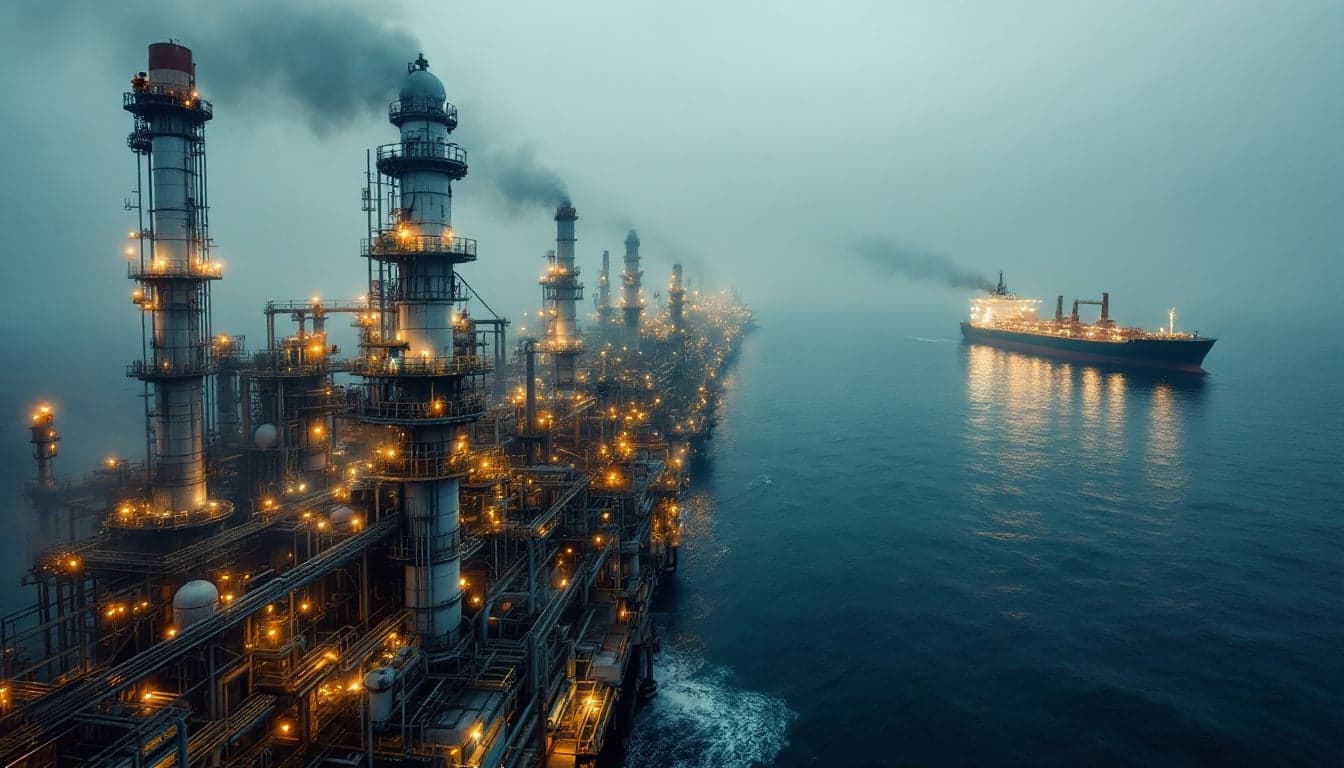
According to OilPrice.com, Ukrainian drone strikes have left three of Russia's six largest diesel-producing refineries either completely offline or operating at roughly one-quarter of nameplate capacity. The six facilities named in the report — Omsk, Kirishi, Taneco, Volgograd, NORSI, and Perm — collectively account for approximately half of Russia's diesel output, based on Reuters calculations from market data. Kirishi is fully offline. Volgograd and NORSI are each running at around 25% of nameplate capacity. The Taneco refinery was struck most recently.
The source article does not specify the full extent of damage at each site or provide a timeline for restoration. What it does establish is that the disruption is concentrated in facilities that form, in the publication's own framing, "the backbone of the country's fuel system."
The scale of the production loss — three of six flagship refineries simultaneously constrained — represents a material shift in Russian diesel availability, with implications that extend well beyond the conflict zone.
Why It Matters
Diesel is the operational fuel of the offshore industry. Every supply vessel, anchor-handling tug, platform support vessel, and diesel-electric drillship running in Brazilian waters consumes marine gasoil derived from diesel refining streams. When a supply shock of this magnitude occurs in a country that has historically been a significant diesel exporter — particularly to markets in Europe and parts of Asia — the redistribution of global diesel flows becomes a relevant variable for Brazilian operators.
Brazil's position here is structurally interesting. Petrobras operates a domestic refining system that, while not fully meeting national diesel demand, has been progressively reducing the country's import dependency. Refineries such as REPLAN, RNEST, and REDUC process domestic and imported crude into diesel that supplies both the onshore transport sector and, indirectly, the offshore logistics chain. A tighter global diesel market raises the replacement cost of any shortfall in domestic production and can pressure margins across the supply chain.
For the Brazilian offshore sector specifically, the more direct exposure is through bunker fuel pricing for support vessels and the cost structure of logistics contractors. OSV operators working under long-term contracts with fixed or semi-fixed day rates absorb fuel cost volatility differently than those on spot arrangements. A sustained period of elevated diesel prices — driven by reduced Russian export availability and the resulting rebalancing of Atlantic Basin supply — would compress margins for vessel operators who cannot pass costs through quickly. This is a dynamic worth tracking for procurement teams and contract negotiators at operators active in the Santos and Campos basins.
There is also a second-order read for Brazil as an oil exporter. Pre-sal crude moves primarily to Asian and European refineries. If European refining margins tighten because of reduced Russian diesel competition in that market, the economics of processing Brazilian crude in European facilities could shift. That is not a near-term price signal, but it is a structural consideration for Petrobras's crude trading desk and for the independent producers — PRIO, Enauta, and others — who sell into international markets.
For the ANP and the broader regulatory environment, the episode is a reminder that energy security arguments in Brazil are not purely domestic. The degree to which Brazil's offshore production contributes to global supply resilience is a policy lever that regulators and the Ministry of Mines and Energy have invoked in licensing rounds. Disruptions of this scale in a major producing country reinforce that framing, even if the direct commercial linkage to Brazil is indirect.
Finally, it is worth noting what this event does not change in the short term. Brazil's offshore production calendar — FPSOs under construction, licensing round schedules, Petrobras's capital program — is not directly responsive to a refinery disruption in Russia. The Brazilian offshore investment cycle operates on a five-to-ten-year horizon; a refinery outage, however significant, does not alter project sanctioning decisions. The relevance is in the margins: fuel costs, crude pricing signals, and the geopolitical context that shapes how international capital views Brazil's offshore sector relative to alternatives.
Context
Russia has historically been one of the world's largest diesel exporters, with European markets having progressively reduced their dependence on Russian fuel since 2022. The redirection of Russian diesel flows toward alternative markets — and the corresponding need for European buyers to source from the United States, Middle East, and India — has already reshaped Atlantic Basin diesel trade patterns over the past several years. A further reduction in Russian refining capacity, if sustained, accelerates that rebalancing.
For Brazilian offshore professionals, the more useful parallel may be the 2022 post-sanctions period, when European diesel tightness briefly elevated bunker costs and compressed margins for vessel operators across the Atlantic. The current disruption is operationally different in origin but structurally similar in its transmission mechanism: reduced Russian output, tighter Atlantic Basin supply, upward pressure on diesel benchmarks.
Source: OILPRICE.COM