CNOOC's TLP floating wind platform points to a new model for offshore decarbonization
Powering oil and gas operations directly from offshore wind changes the logic of emissions reduction at sea — and sets a reference point for Brazil's pre-sal operators.
THE NEWS
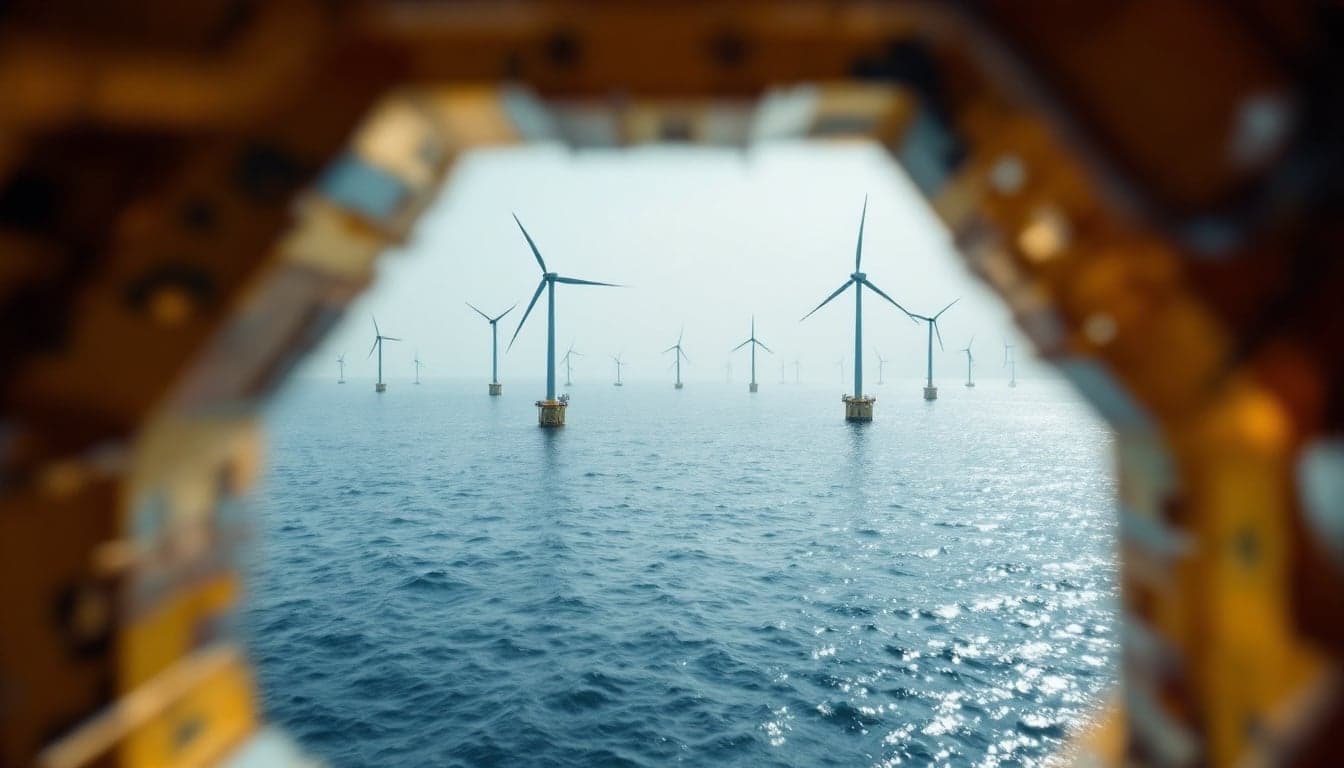
According to Marine Insight, China has deployed what is described as the world's first tension-leg platform (TLP) floating offshore wind installation with a single-unit capacity of 16 megawatts. The platform departed its assembly site in Zhuhai, Guangdong Province, and is heading to the Lufeng oilfield cluster in the South China Sea.
Developed by CNOOC, the structure stands more than 307 metres tall, weighs nearly 8,000 tonnes, and is held in position by taut steel cables anchored to the seabed — the defining characteristic of a TLP mooring system. Unlike fixed-bottom offshore wind installations, the platform floats and is designed to remain stable in deep and rough water conditions.
Rather than feeding electricity into a mainland grid, the platform will transmit power via subsea cables directly to offshore oil and gas production facilities at the Lufeng oilfield cluster. Once operational, it is expected to generate approximately 54 million kilowatt-hours annually, cutting around 35,000 tonnes of CO₂ emissions per year and saving approximately 15,000 cubic metres of fuel oil annually.
WHY IT MATTERS
The configuration CNOOC has deployed — floating wind dedicated to offshore industrial load rather than grid export — represents a structural departure from how offshore wind projects are typically conceived. Most floating wind developments are designed to deliver electricity to shore. This project inverts that logic: the offshore oil and gas asset is the customer, and the wind platform is sized and positioned to serve it. That distinction has direct relevance for any operator running energy-intensive production infrastructure far from shore.
For Brazilian offshore operators, the parallel is immediate. Petrobras and its consortium partners operate some of the most energy-intensive FPSOs in the world, anchored in ultra-deep pre-sal waters where diesel and gas turbine generation accounts for a meaningful share of operational emissions. The Brazilian pre-sal fields sit in water depths broadly comparable to environments where floating wind technology is now being validated. The Lufeng deployment does not prove that floating wind is ready for the Santos Basin — but it does advance the body of operational evidence that the industry needs before such applications become investable.
The TLP mooring system chosen by CNOOC is technically significant in this context. TLP configurations are well understood in the offshore oil and gas sector — Petrobras itself has operated TLP-type structures — which means the engineering vocabulary for this type of floating platform already exists within the Brazilian supply chain and regulatory framework. Whether that familiarity translates into faster permitting or local content pathways for a future Brazilian floating wind project is a question worth tracking, but the conceptual bridge is shorter than it might appear from a pure renewables-industry perspective.
The emissions reduction figures cited in the source — approximately 35,000 tonnes of CO₂ per year and roughly 15,000 cubic metres of fuel oil saved annually — offer a concrete reference for Brazilian operators and their regulators when modelling the decarbonization potential of equivalent offshore wind-to-platform configurations. Brazil's regulatory trajectory, including ANP's evolving framework around emissions reporting and Petrobras's own decarbonization commitments, creates a medium-term context in which this kind of operational data becomes more than academic. Operators and their engineering teams will be watching what CNOOC learns from the Lufeng integration closely.
There is also a supply chain and industrial policy dimension worth noting. China's ability to construct, commission, and deploy a structure of this scale and novelty reflects sustained investment in domestic floating offshore wind manufacturing capacity. Brazil has articulated ambitions in the floating wind sector, with several development-stage projects under discussion and a regulatory framework at early stages of formation. The gap between China's current operational capability and Brazil's development pipeline is substantial — but that gap is also an argument for Brazilian policymakers and operators to sharpen their engagement with floating wind now, while the technology is still maturing globally and before supply chains consolidate around a small number of established providers.
CONTEXT
The Lufeng deployment arrives as the global floating offshore wind sector moves from demonstration projects toward early commercial scale. Several European projects — including developments in Norwegian and Scottish waters — have been advancing semi-submersible and spar-buoy configurations, making CNOOC's TLP approach a distinct technical path rather than a replication of existing models. The choice of TLP mooring for a wind application at this scale is itself a data point: it suggests that oil-and-gas mooring engineering is being actively transferred into the wind sector, rather than the two industries developing in parallel.
For Brazil, the more immediate comparable may be the broader question of how offshore operators integrate renewable generation into their energy balances without waiting for grid infrastructure that does not yet exist in deep water. The Lufeng model — dedicated offshore wind serving dedicated offshore load — sidesteps the grid question entirely. That is a pragmatic architecture, and one that Brazilian operators and their engineering contractors are likely already evaluating in internal roadmaps.