Conflicting accounts over Sea of Oman raise the stakes for crude transit
Iran and the US offer irreconcilable versions of a naval encounter — and the uncertainty itself carries a freight cost.
The News
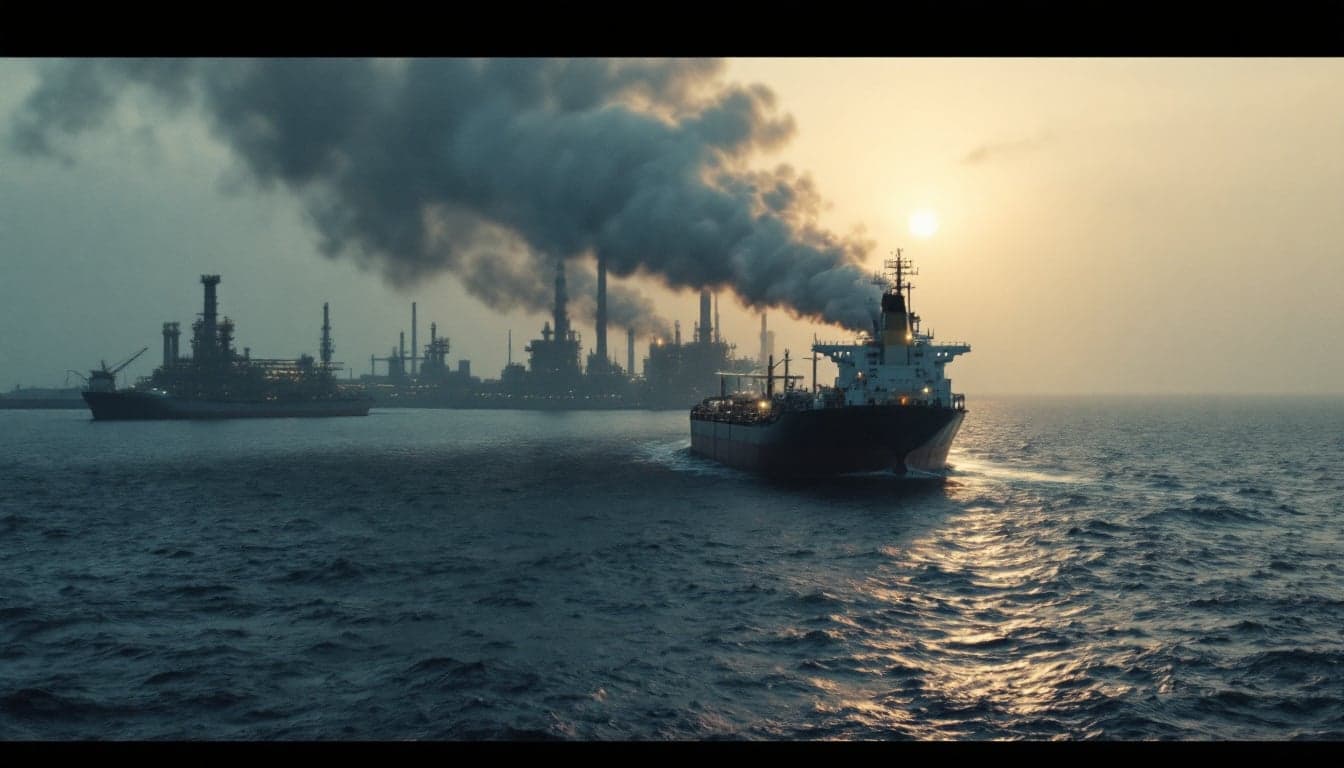
According to Marine Insight, Iran's navy stated on Friday that it fired warning shots at two US Navy guided-missile destroyers in the Sea of Oman, claiming the vessels subsequently withdrew toward the Indian Ocean. Tehran's statement attributed the action to Qadir cruise missiles and Shahid Dana offensive drones, and extended the claim to include the amphibious assault ship USS Tripoli, which Iran said had also been compelled to leave the area in a prior operation. The Iranian statement did not specify when the alleged incidents took place.
Within an hour, US Central Command (CENTCOM) issued a direct rebuttal on X, stating that Iranian forces did not attack or fire upon US Navy warships and that such an action "would be a serious violation of the cease-fire." CENTCOM added that US forces continue to operate freely in regional waters and are actively enforcing an ongoing blockade against Iran. The two destroyers in question were operating as part of the USS George H.W. Bush carrier strike group.
Separately, Iran's Navy Operations Command issued a warning that longer-range missiles would be deployed if US ships moved beyond the range of weapons already in position. Tehran framed the alleged operation as a response to what it described as US interference with commercial shipping and the seizure of Iranian oil tankers. The US naval blockade of Iran has been in place since late April, and the Sea of Oman — the waterway connecting the Strait of Hormuz to the Arabian Sea — has become the primary zone of confrontation between the two navies. Also on Friday, the US Indo-Pacific Command reported the interception of a sanctioned stateless tanker, the M/T Davina, in the Indian Ocean as part of the broader blockade enforcement campaign.
Why It Matters
For Brazilian offshore professionals, the Sea of Oman and the Strait of Hormuz are not abstractions. The strait is the single most consequential chokepoint in global crude logistics, and the waterway carries a large share of the world's crude oil trade, as Marine Insight notes. Any sustained disruption — real or perceived — propagates through Brent pricing, tanker freight rates, and ultimately the netback calculations that underpin investment decisions in Brazilian deepwater.
The immediate market signal here is not the incident itself but the informational gap between the two accounts. When two parties with direct operational knowledge of the same event offer flatly contradictory versions, market participants cannot price risk with confidence. That uncertainty premium tends to be additive: freight rates on Middle East crude routes typically firm when naval incidents are reported, regardless of whether they are later confirmed or denied. Brazilian operators and traders who source spot cargoes from the Gulf region will be watching whether that premium persists.
Brazil's own crude export position adds a second dimension. Pre-sal volumes compete with Middle Eastern grades in Asian markets, particularly in China, South Korea, and Japan. When Middle Eastern supply routes face perceived disruption risk, pre-sal's Atlantic routing becomes comparatively more attractive to Asian buyers. This dynamic does not require an actual closure of the Strait of Hormuz — it operates at the level of insurance costs, vessel scheduling, and buyer diversification strategy. A prolonged period of elevated tension in the Sea of Oman, even without a confirmed kinetic incident, is structurally supportive of demand for Atlantic Basin crude.
The blockade context is also worth holding carefully. CENTCOM's statement frames the current naval posture as blockade enforcement operating under a ceasefire agreement — a combination that creates its own legal and operational ambiguities. If the ceasefire framework were to break down, the escalation pathway would move quickly from naval confrontation to broader energy market disruption. Brazilian operators with exposure to global crude benchmarks, LNG pricing, or shipping insurance costs have a direct interest in how that framework holds.
For Petrobras and other Brazilian producers, the more immediate operational question is tanker availability and routing. A scenario in which more vessels opt for longer routes around the Cape of Good Hope — as occurred during periods of Red Sea disruption — would tighten global tanker capacity and push up freight costs across all routes, including those serving Brazilian export terminals. The M/T Davina interception reported on the same day signals that the enforcement perimeter extends into the Indian Ocean, which broadens the geographic zone of operational uncertainty for vessel operators.
Context
The current episode fits a pattern that the offshore industry has navigated before. During the 2019 tanker attacks in the Gulf of Oman, the insurance market responded within days with war-risk surcharges that cascaded across all regional routes. The Red Sea disruptions of 2023-2024 demonstrated how a sustained threat environment — even one that did not close a chokepoint outright — could structurally reshape tanker routing and add weeks to voyage times. Brazilian operators and their logistics teams will be drawing on both of those precedents as they assess the current situation.
What distinguishes the present moment is the explicit ceasefire framing cited by CENTCOM. That framing implies a negotiated boundary whose terms are not publicly detailed, and whose durability is now being tested by competing public narratives. The offshore industry does not require resolution of the underlying geopolitical dispute to manage its exposure — but it does require a stable enough operating environment to plan vessel schedules, hedge freight costs, and maintain cargo insurance at workable rates. Whether that stability holds will become clearer in the days following this exchange of statements.
Source: MARINE INSIGHT