Hormuz in quiet mode: what the U.S. shift means for tanker routing
Washington has moved from overt escort plans to discreet coordination with shippers — a tactical adjustment with direct implications for global crude flows.
The news
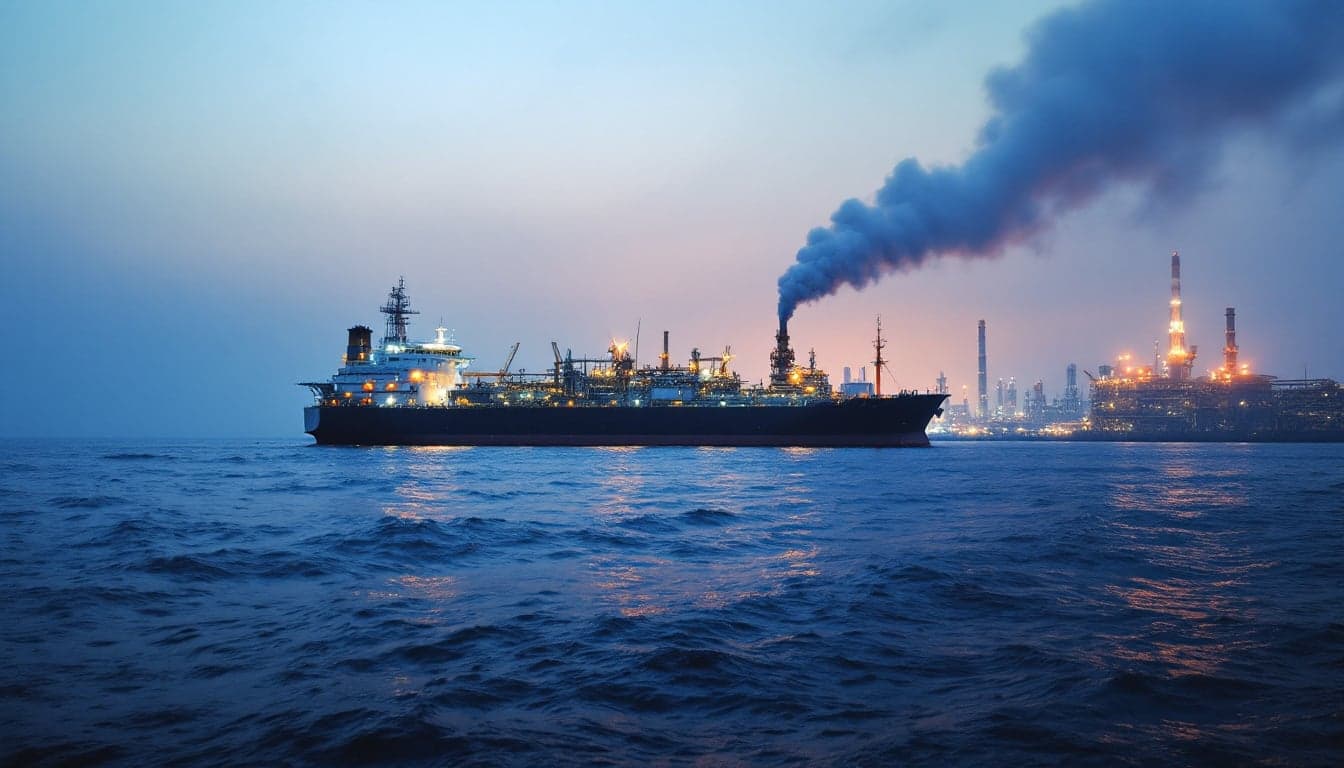
According to Marine Insight, the U.S. administration has adopted a quieter, non-confrontational approach to helping commercial vessels transit the Strait of Hormuz, stepping back from an earlier, more visible escort plan that President Trump had called Project Freedom. The revised approach involves Washington coordinating with shipping companies and operators — suggesting alternative routes and providing protection — without the formal, publicly announced naval escort framework that was dropped approximately a month prior.
Under the new arrangement, ships are crossing the strait by turning off their transponders to reduce their detection profile and routing along the southern side of the waterway, near the Omani coast, where the risk of Iranian naval mines is described as lower. On June 1, 2026, CENTCOM public affairs director Tim Hawkins clarified the posture: "Though US forces are not escorting, we continue to communicate and coordinate with commercial ships seeking to freely and safely transit the Strait of Hormuz."
The operational picture sharpened further on June 2, 2026, when CENTCOM reported that its forces had shot down Iranian drones targeting civilian mariners transiting the waterway. Secretary of State Marco Rubio confirmed at a House Foreign Affairs Committee hearing on June 3 that the U.S. was actively intercepting Iranian drones aimed at commercial vessels, and that Iran was responding to those actions. Two shipping operators, speaking anonymously, confirmed they had contacted the U.S. military for navigational guidance on the strait.
Why it matters
For Brazilian offshore professionals, the Strait of Hormuz can appear geographically remote, but its operational status is directly coupled to the global crude market in which Petrobras, PRIO, Enauta, and their trading counterparts operate. A sustained disruption to tanker flows through Hormuz — which handles a substantial share of seaborne crude and LNG — exerts upward pressure on benchmark prices and, by extension, on the fiscal assumptions underlying Brazil's pre-sal development programs.
The structural read here is that the current situation is neither a clean blockade nor a free-transit environment. It is a managed ambiguity: ships are moving, but under conditions that introduce meaningful operational risk — transponders off, routing constrained to the southern channel, military coordination required on a case-by-case basis. For risk managers at Brazilian trading desks and vessel operators with exposure to Middle Eastern crude, this ambiguity is itself a cost. Insurance premiums for war-risk coverage in the Persian Gulf have historically spiked during periods of exactly this kind of low-grade, persistent threat, and that premium feeds directly into voyage economics.
The decision by CENTCOM to revise its public statements — moving from a denial of involvement to an acknowledgment of coordination — is analytically significant. It suggests that the operational reality on the water was diverging from the official posture, and that the revision was driven by emerging evidence rather than a proactive communications strategy. For shipping companies weighing whether to contact U.S. military assets for guidance, this sequence may affect their confidence in the reliability of official communications during future escalations.
For Brazil specifically, the medium-term routing question is worth watching. Brazilian crude exports — predominantly pre-sal grades moving to Asian buyers — do not transit Hormuz. But Brazil is a net importer of refined products and, depending on the cargo mix, some operators source crude or intermediates from the Gulf region. More importantly, any sustained rerouting of tankers away from Hormuz — around the Cape of Good Hope, for instance — tightens global tanker supply, which affects freight rates on routes that do involve Brazil, including the key VLCC lanes to China and the Atlantic basin trade.
The broader signal from this episode is about the evolving role of state actors in commercial maritime operations. The model now visible in Hormuz — where military assets provide route guidance, drone suppression, and implicit protection without formal escort contracts — represents a different kind of public-private interface than the industry has been accustomed to. Brazilian maritime regulators and operators would be well-served to track how this model develops, particularly as discussions around naval presence in the South Atlantic and the security of Brazilian offshore infrastructure periodically resurface in policy circles.
Context
The Strait of Hormuz has been a recurring focal point for tanker security planning since the tanker wars of the 1980s. The current episode echoes, in some structural ways, the 1987-1988 Operation Earnest Will, in which the U.S. Navy formally escorted reflagged Kuwaiti tankers through the waterway — a markedly more overt arrangement than what is now being described. The shift toward informal coordination and transponder-off routing reflects both the changed geopolitical calculus around the Iran ceasefire and the lessons operators have drawn from previous escalation cycles.
For the Brazilian offshore sector, the more relevant parallel may be the 2019 Gulf of Oman tanker incidents, which produced a measurable but temporary spike in war-risk insurance premiums and prompted several operators to review their routing assumptions for Middle Eastern cargo. The current situation has persisted longer and involves more direct military engagement, which suggests the insurance and routing adjustments now underway may prove more durable than those seen in 2019.