Washington's Hormuz cost-recovery demand adds a new variable to crude routing
A US proposal to charge a 20% levy on Hormuz transit trade reshapes the freight calculus for any cargo moving through the strait.
THE NEWS
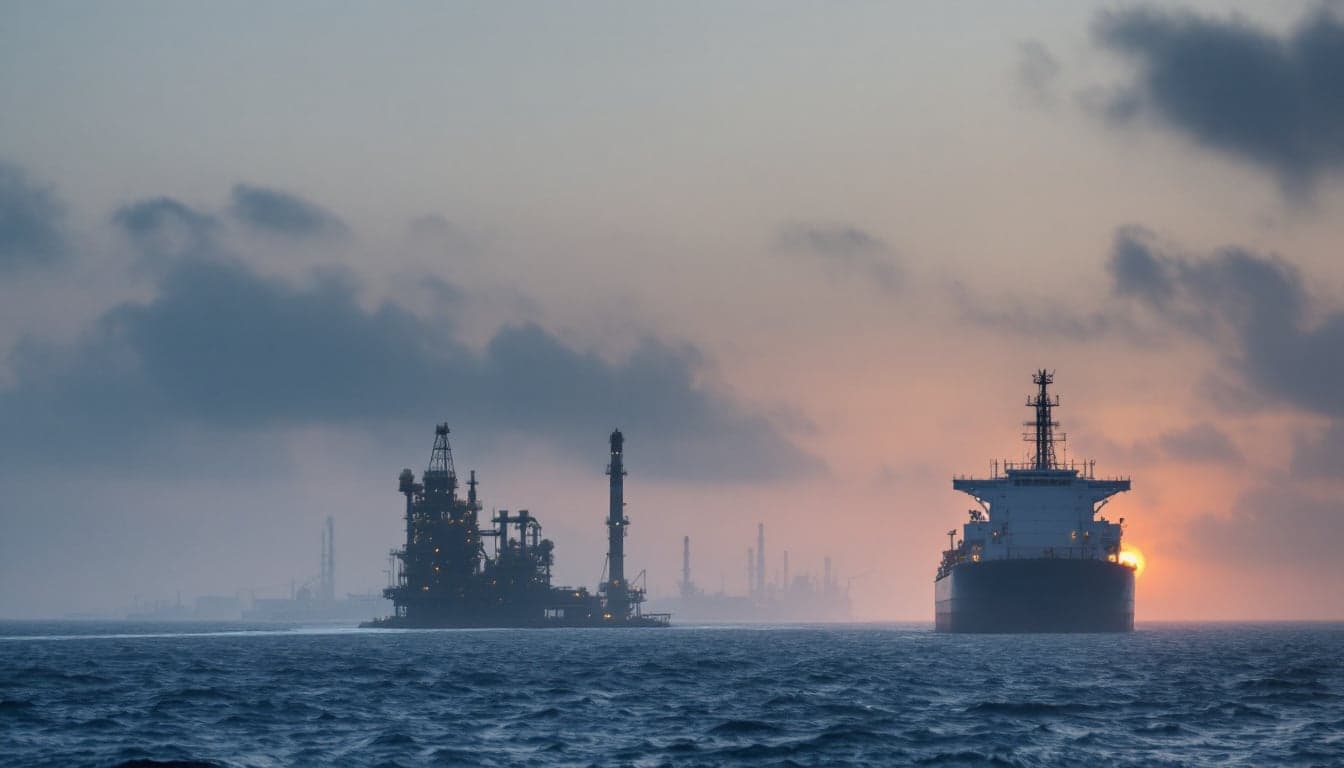
According to Seatrade Maritime, the United States is seeking to reinstate a blockade of Iranian ports and to recover the costs of defending the Strait of Hormuz by imposing what President Trump described as a 20% charge on trade passing through the waterway. The announcement frames the levy as a cost-recovery mechanism tied directly to US naval presence in the region.
The proposal, as reported, links the financial demand to the argument that the US military provides the security infrastructure that keeps the strait navigable for commercial shipping. The president's framing positions the charge as a condition of continued access rather than a conventional tariff.
No implementation timeline, enforcement mechanism, or treaty basis was specified in the report. The measure remains at the declaratory stage, and its legal and operational architecture has not been publicly defined.
WHY IT MATTERS
The Strait of Hormuz is the single most consequential maritime chokepoint for global crude oil and LNG flows. Any credible interference with transit — whether through blockade, military action, or the imposition of a cost structure that alters freight economics — carries immediate implications for oil price benchmarks, tanker routing decisions, and the risk premiums embedded in shipping contracts. For Brazilian offshore professionals, the relevance is not abstract: Brazil is a net crude exporter, and the pricing of its Atlantic Basin grades is set against benchmarks that are themselves sensitive to Persian Gulf supply dynamics.
The most direct first-order effect, if the measure were to advance toward implementation, would be on tanker freight rates for voyages originating in or transiting the Gulf. A 20% levy applied to the cargo value — or even to the freight value, depending on how the mechanism is ultimately structured — would represent a material cost increase for buyers of Gulf crude. That cost would not disappear; it would be redistributed across the supply chain, most likely absorbed in part by refiners and in part reflected in the spread between Gulf and non-Gulf grades. Brazilian pre-sal crude, sold on Atlantic Basin pricing, would become relatively more attractive to refiners seeking to avoid the levy's exposure.
For Petrobras and the other operators active in Brazilian waters, the scenario is worth monitoring precisely because Brazilian export grades compete directly with Middle Eastern and West African barrels in Asian refinery slates. Any structural increase in the delivered cost of Gulf crude to Asian buyers — even a temporary or partial one — tends to redirect purchasing interest toward Atlantic Basin alternatives. This dynamic has played out in prior periods of Hormuz tension, and the pattern is well understood by the commercial teams at major Brazilian operators.
The second-order effect concerns LNG. Brazil is not a major LNG exporter at this stage, but the country's energy matrix is sensitive to global LNG pricing through its import exposure and through the competitive dynamics affecting gas-linked power generation. A sustained disruption to Hormuz LNG flows — the strait handles a significant share of global LNG trade — would tighten the global LNG balance and push spot prices upward. That has mixed implications for Brazil: it raises the cost of any spot LNG imports the country requires, but it also improves the economics of domestic gas monetization projects and potentially accelerates investment decisions in Brazilian offshore gas infrastructure.
The more cautious read, however, is that the measure as currently described is a declaratory position rather than an operational policy. The gap between a presidential statement and an enforceable maritime levy is substantial. It would require a legal framework, international acceptance or at minimum acquiescence from flag states, and a credible enforcement mechanism — none of which have been outlined. Markets will price in some risk premium on the announcement alone, but the structural freight and pricing adjustments described above would only materialize if the policy advances toward implementation. Brazilian operators and their commercial counterparts would be well served by tracking the legal and diplomatic developments that follow, rather than repositioning on the basis of the current statement alone.
CONTEXT
Periods of elevated Hormuz tension — including the tanker incidents of 2019 and earlier episodes of Iran-US confrontation — have consistently produced short-term freight rate spikes and temporary widening of the Brent-Dubai spread, which benefits Atlantic Basin exporters. The duration and magnitude of those effects has historically depended on whether physical flows were actually disrupted or whether the tension remained at the rhetorical level. That distinction remains the key variable to watch in the current episode.
For the Brazilian offshore sector, the structural read is familiar: geopolitical risk concentrated in the Persian Gulf tends to improve the relative positioning of stable, deepwater Atlantic Basin supply. That is a long-running theme in the investment case for Brazilian pre-sal development, and the current news cycle adds another data point to it — without, at this stage, changing the underlying fundamentals.